
Press Release – October 18th 2022
Nouhaila Oudija – RE USA researcher and consultant
New research shows disconnect between Economics curricula and the societal and economic issues students are most concerned about.
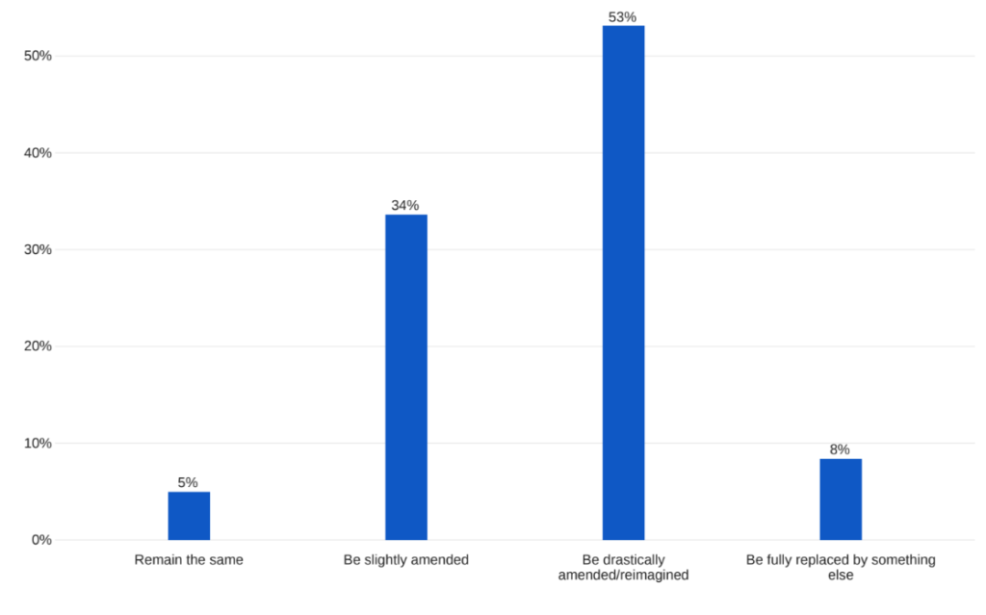
A cornerstone finding of this survey was that 95% of college students believe that the current economic system in the US should change, 61% of which believe that it should be drastically amended or reimagined, or fully replaced by something else.
If you would like to get in touch about this research or would like to feature the results in your publication, contact comms.usa@rethinkeconomics.org
Topline Results
- 95% of US college students believe that the current economic system in the US should change
- 63% of US college students believe their generation will be worse off economically than their parents’
- The issues of most concern to US college students are the economy, racism, and climate change.
- 78% of US Economics students have not learned about environmental or ecological economics
- 92% of US Economics students have not learned about Stratification or Feminist economics
Drawing on a survey of over 2000 US undergraduate college students, new research from Rethinking Economics USA, in partnership with the Roosevelt Network, illustrates how economics across US universities is failing to address the societal and economic issues students report being most concerned about. The study uncovers an important finding: that the majority of college students are critical of the US economic system, with the large majority believing it ought to change.
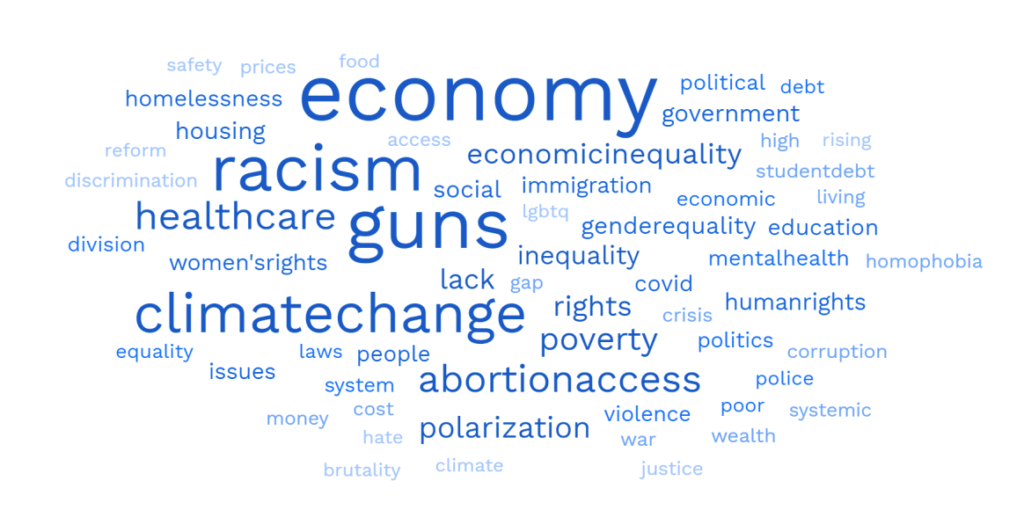
When asked what students believed to be the most pressing issues in the US today, the top areas of concern reported were the economy, racism, and climate change, in addition to issues like guns, abortion access, healthcare, and economic inequality.
However, looking at a sample of over 300 economics students, it was found that most of them have not learned about the very schools of economic thought that put these issues at the center. For example, 78% reported not having learned about environmental or ecological economics, while 93% revealed they had not studied Feminist or Stratification Economics (which deal with gender and race).
The lack of pluralism in economics curricula and the unquestioned dominance of the neoclassical paradigm over others was further demonstrated by the survey. 91% of economics students reported never having heard of heterodox economics and only 33% could correctly identify having learned about neoclassical economics.
These results show that the economics discipline’s intellectual monism and lack of attention to prime economic, social, and environmental issues is grossly inadequate with what was found to be the biggest areas of concern for US college students—77% of whom will choose to study economics at the high school or college level.
This inadequacy further stands out against the striking finding that most college students are critical of the US economic system and apprehensive of their prospects within it. Indeed, when asked to describe the US economic system in 3 words, the adjectives most commonly used were: “Unfair”,“Unequal”, “Poor”, “Capitalist”, “Bad”, “Broken”, and “Corrupt”. Moreover a sizable 63% of college students believe their generation will be worse off economically than their parents’, compared to a mere 11% who believe they will be better off.
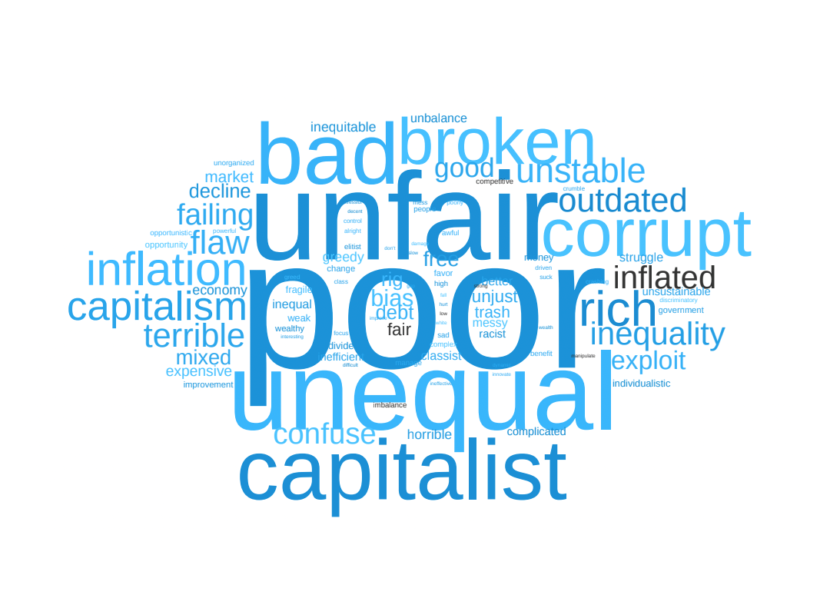
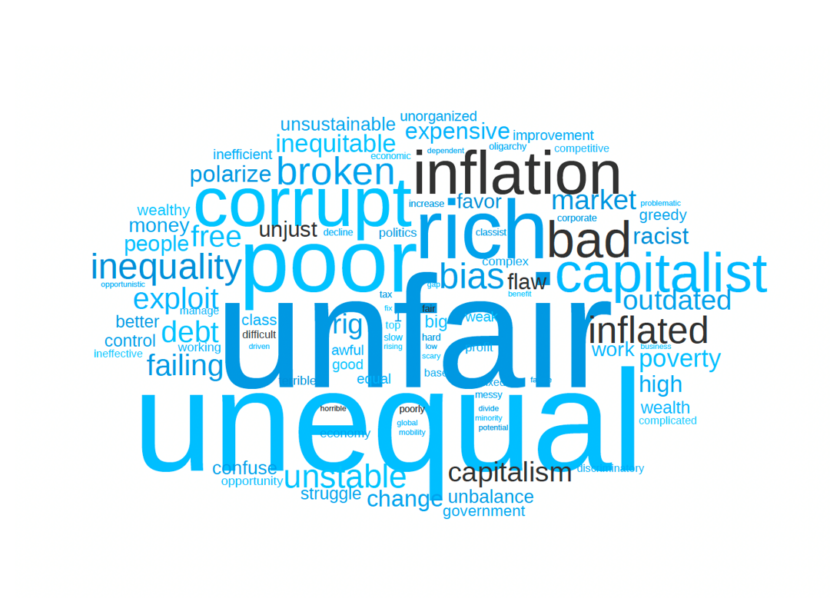
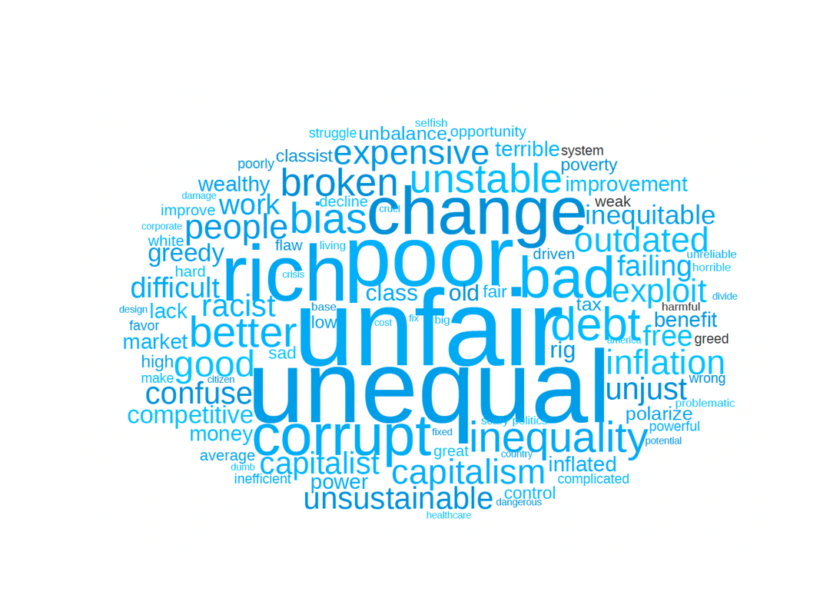
( In 3 words or phrases, please describe what you think of the economic system in America )
Lastly, in a cornerstone finding of this survey, it was revealed that 95% of college students believe that the current economic system in the US should change. 61% of them being of the opinion that it should be drastically amended/reimagined or fully replaced by something else.
“ This data is a very significant illustration of young people’s awareness of the economic and social environment around them. They seem to have a real sense that something is wrong with the economic system they live in and are worried about their prospects within it. According to the survey, the number one source that students turn to to understand issues facing the US economy and democracy are courses and academic material. 77% of our sample reported having studied economics at high school or college level, yet economics is largely silent about the issues most relevant to our work and to the younger generation.
This is why we believe that economics education needs to be diversified, decolonized, democratized, and decarbonized. We also believe that students have the power and willingness to effect this change, given that the number one motivation they reported for studying their subject was to make the world a better place.
Laurence Jones-Williams, Director of Rethinking Economics International
If you would like to get in touch with us about this research or would like to feature the results in your publication, please contact comms.usa@rethinkeconomics.org
The survey was carried out by Generation Lab, a leader in youth polling in the United States. For more information about survey methodology, contact cyrus@generationlab.org
You can find more of the survey results and information on methodology here
Big thanks to the Omidyar Network’s Reimagining Capitalism program for funding this project.
Join Rethinking Economics and work with a global community of students and academics transforming their education
Sign up to get involved with the RE movement or get in contact with comms.usa@rethinkeconomics.org for more information.
You can find REUSA on Twitter at @RethinkEcon_USA
Who we are
Rethinking Economics USA is a budding national network of students, academics, and professionals campaigning to forge an Economics discipline that is pluralist, critical, democratized, & real-world focused. Our vision is of economies that place people and the planet at their center and we believe that economics has the crucial role of forwarding the ideas, approaches, and solutions that will allow for that transition.
The Roosevelt Network develops and supports undergraduate college students and early career professionals—in particular, those who hold identities historically denied political power—to be the next generation of leaders in the progressive policy ecosystem. We are creating a pipeline of new leaders who champion ideas that rebalance power in our economy and democracy. As a program of the Roosevelt Institute stewarding the legacy of Eleanor & Franklin Roosevelt into the 21st century, we believe that we can rewrite the rules by changing who writes them.
Teaching Economics Through Movements for Justice: Reflections from the Classroom
Sasha High introduces us to the Movements for Economic Justice course at John Jay College and its role in situating students in the political economy of the 21st Century.
Wednesday 11 March 2026

Reflections on economic reasoning
What do economists actually do – and why? A first-year module lecturer at Goldsmiths revisits the basics of economic reasoning to reflect on how economists think, what the discipline studies, and what that says about the state of the profession today.
Wednesday 17 December 2025

Curriculum Health Check update: University of Leeds
University of Leeds is an undergraduate course that Rethinking Economics UK argues fits many of the principles that we want to see from an economics education.
Tuesday 4 November 2025